
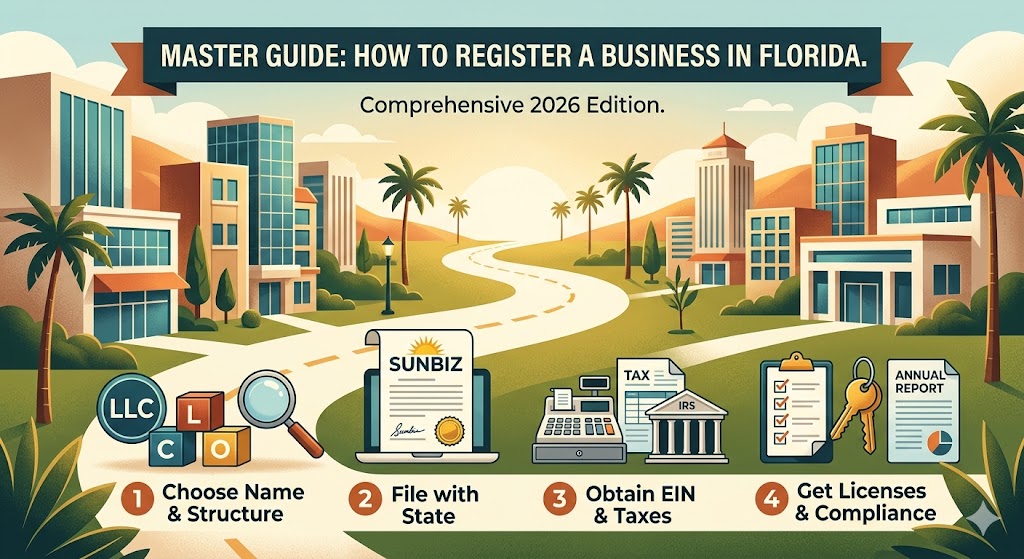
A Comprehensive Step-by-Step Guide for Entrepreneurs | Updated April 2026
Step 1: Introduction — Why Florida Is a Top State for Business
Florida consistently ranks as one of the best states in the nation for starting a business. With over 3.5 million registered business entities, no personal state income tax, a competitive corporate tax rate, 21 foreign trade zones, and a large, diverse workforce, the Sunshine State offers entrepreneurs a genuinely favorable environment for growth.
Whether you are launching a home-based startup or expanding an out-of-state company into a new market, properly registering your business in Florida is a foundational legal requirement. Failure to register correctly can result in fines, loss of liability protections, and difficulty opening a business bank account or securing financing.
This guide walks you through every step of the process — from choosing a business structure to staying compliant year after year — with direct contact information for every relevant government agency.
Step 2: Choose Your Business Structure
The most important decision you will make before registering is selecting the right legal structure. Your choice directly affects your personal liability, how you are taxed, your ongoing compliance obligations, and your ability to raise capital or bring on partners.
Sole Proprietorship
The simplest structure — no formal state filing is required unless you operate under a trade name other than your legal name. However, there is no separation between your personal and business assets, meaning your home, car, and savings are exposed if the business faces a lawsuit or debt.
General Partnership
Formed automatically when two or more people co-own a business for profit. Owners bear unlimited personal liability. A written partnership agreement is strongly recommended to define roles, responsibilities, and profit splits.
Limited Liability Company (LLC)
The most popular structure for small and mid-sized businesses in Florida. An LLC combines the liability protection of a corporation with the tax flexibility of a partnership. Owners (called “members”) are generally shielded from personal liability for business debts and lawsuits. Florida LLCs can elect to be taxed as a sole proprietorship, partnership, S-Corp, or C-Corp.
Corporation (S-Corp and C-Corp)
A more formal entity that issues stock and is owned by shareholders. C-Corporations are taxed as a separate entity, which can create double taxation. S-Corporations pass income through to shareholders’ personal returns but are limited to 100 U.S. shareholders. Corporations require annual meetings, corporate minutes, and more formal governance.
Pro Tip: Most Florida small business owners choose an LLC for its combination of liability protection, tax flexibility, and relatively simple ongoing compliance. Consult with a CPA or business attorney before deciding.
Step 3: Choose and Reserve Your Business Name
Your business name is one of your most valuable assets. Florida has specific naming rules and you must verify availability before filing any formation documents.
Florida Business Naming Requirements
- The name must be “distinguishable” from all other registered entities in the state — even when modified by an abbreviation or punctuation.
- LLCs must include “Limited Liability Company,” “LLC,” or “L.L.C.” in the name.
- Corporations must include “Corporation,” “Incorporated,” “Corp.,” “Inc.,” or “Co.”
- Names cannot imply government affiliation or use restricted words like “Bank,” “Attorney,” or “University” without proper authorization.
How to Search for Name Availability
Conduct a free name search through Florida’s official business portal, Sunbiz, at www.sunbiz.org. Search the entity name database to confirm no other business is using your desired name. Also search the U.S. Patent and Trademark Office (USPTO) database at www.uspto.gov to check for federally registered trademarks.
Name Reservation (Optional)
If you are not ready to file formation documents immediately, you can reserve a name for 120 days. The fee is $25 for LLCs and $35 for corporations. A reservation holds the name in the state filing system but does not provide trademark protection.
Fictitious Name / DBA Registration
If you operate under a name other than your own legal name — or if your LLC or corporation does business under a brand name different from its registered legal name — you must register a Fictitious Name (commonly called a “DBA” — Doing Business As). Fictitious name registrations are filed with the Florida Division of Corporations and cost $50. Before filing, you must publish a notice of intent to use the fictitious name in a newspaper of general circulation in the county where the business is located.
Step 4: Designate a Registered Agent
Every Florida business entity — LLC, corporation, or partnership — is required by law to designate and maintain a registered agent. This is the official point of contact for receiving legal documents, government notices, and service of process on behalf of your business.
Who Can Serve as Registered Agent?
- An individual Florida resident (age 18+) with a physical street address in Florida. P.O. Boxes are not accepted.
- A business entity authorized to conduct business in Florida with a physical Florida address.
- You may serve as your own registered agent if you are a Florida resident with a physical in-state address.
Professional Registered Agent Services
Many owners hire a professional registered agent service, typically costing $50–$300 per year. This is especially useful if you work from a home office and prefer not to list your personal address in the public state records database, or if you are not always available during business hours to receive documents. Common providers include Northwest Registered Agent, CT Corporation, and Registered Agents Inc.
Important: Your registered agent’s name and address are public record in the Sunbiz database. Plan accordingly — especially if you work from a home office.
Step 5: File Formation Documents with the State
Once you have selected your structure, confirmed your business name, and designated a registered agent, you are ready to file your official formation documents with the Florida Division of Corporations through Sunbiz.
Filing an LLC — Articles of Organization
To formally create a Florida LLC, file Articles of Organization (Form LLC-1) with the Division of Corporations. You can file online at www.sunbiz.org or submit a paper form by mail. Required information includes:
- The LLC’s official name (including the LLC designation)
- The principal place of business (must be a physical Florida address)
- The name and address of the registered agent
- The name and address of each organizer (the person filing the documents)
- Whether the LLC will be managed by its members or by designated managers
Filing a Corporation — Articles of Incorporation
To form a Florida profit corporation, file Articles of Incorporation (Form CR2E002) through Sunbiz. Required information includes:
- The corporation’s official name (including the corporate designation)
- The number of shares the corporation is authorized to issue
- The principal office address
- The name and address of each registered agent and incorporator
Online vs. Mail Filing
Online filing through Sunbiz is strongly recommended. It is processed within 1–3 business days, lets you track your application status, and is available 24/7. Paper filings by mail can take 2–4 weeks, especially during peak periods in early spring.
Florida Division of Corporations (Sunbiz) Address: The Centre of Tallahassee, 2415 N. Monroe Street, Suite 810, Tallahassee, FL 32303 Mailing: P.O. Box 6327, Tallahassee, FL 32314 Phone: (850) 245-6000 | Internet Access Line: (850) 245-6939 Hours: Monday–Friday, 8:00 a.m. – 5:00 p.m. EST | Sunbiz portal available 24/7 Website: www.sunbiz.org | dos.fl.gov/sunbiz Email: corpfilings@dos.myflorida.com (new filings) | corporations@dos.myflorida.com (general)
Step 6: Obtain a Federal Employer Identification Number (EIN)
An Employer Identification Number (EIN) — also called a Federal Tax ID — is issued by the IRS and functions like a Social Security Number for your business. It is required to open a business bank account, hire employees, and file certain tax returns.
Who Needs an EIN?
- All corporations and multi-member LLCs are required to obtain an EIN.
- Single-member LLCs that have employees or elect to be taxed as a corporation require an EIN.
- Sole proprietors and single-member LLCs with no employees may use their SSN but are often better served by obtaining an EIN to protect their personal information.
How to Apply
Apply for an EIN for free at www.irs.gov/ein. The online application is the fastest option — you receive your EIN immediately upon completion. You can also apply by fax or mail using Form SS-4. Never pay a third party for this service; it is always free directly from the IRS.
Internal Revenue Service (IRS) — EIN Applications Phone: (800) 829-4933 (Business & Specialty Tax Line) Hours: Monday–Friday, 7:00 a.m. – 7:00 p.m. local time Website: www.irs.gov/ein
Step 7: Register for Florida State Taxes
Even though Florida has no personal state income tax, most businesses are required to register with the Florida Department of Revenue for one or more state taxes.
Sales and Use Tax
If your business sells taxable goods or services, you must register as a sales and use tax dealer before you begin conducting business. Florida’s base sales tax rate is 6%, with counties authorized to add a discretionary surtax of up to 1.5%. Register online using the Florida Business Tax Application (Form DR-1) at floridarevenue.com.
Corporate Income Tax
Florida imposes a corporate income tax on C-Corporations at a rate of 5.5%. LLCs taxed as pass-through entities, S-Corporations, and sole proprietors are generally exempt. If subject to this tax, you must file a Florida Corporate Income Tax Return (Form F-1120).
Reemployment Tax (Unemployment Insurance)
If you have employees, register with the Florida Department of Revenue for Reemployment Tax. The initial rate for new employers is 2.7% on the first $7,000 of each employee’s wages per year.
2025 Update — Commercial Rent Sales Tax Repealed
Effective October 1, 2025, the state sales tax on commercial real property rentals — including office space, retail space, warehouses, and self-storage units — was fully repealed. This is a significant change for any Florida business that leases commercial space.
Florida Department of Revenue Address: 5050 West Tennessee Street, Tallahassee, FL 32399-0100 Phone: (850) 488-6800 Website: floridarevenue.com Online Registration: taxapps.floridarevenue.com/taxregistration
Florida DOR Regional Service Centers:
- Tallahassee: 5050 West Tennessee Street | (850) 488-6800
- Jacksonville: 921 N. Davis Street, Building A | (904) 798-4900
- Tampa: 6302 E. Martin Luther King Jr. Blvd | (813) 630-1200
- Fort Lauderdale: 100 West Sunrise Blvd | (954) 958-7000
- Miami: 8175 NW 12th Street, Suite 119 | (305) 470-5001
- Maitland (Orlando area): 2301 Maitland Center Pkwy, Suite 200 | (407) 481-5800
Step 8: Obtain Required Business Licenses and Permits
Florida does not issue a single general state business license. Instead, licensing is handled at the state, county, and city levels depending on your industry, profession, and physical location.
State-Level Professional Licenses (DBPR)
The Florida Department of Business and Professional Regulation (DBPR) licenses more than 1.8 million businesses and professionals across nearly 200 license types. If you work in a regulated profession — including construction, real estate, cosmetology, food service, hospitality, or healthcare — you are likely required to obtain a DBPR license before operating. Search for your license type and apply at www.myfloridalicense.com.
Florida Department of Business and Professional Regulation (DBPR) Address: 2601 Blair Stone Road, Tallahassee, FL 32399-1027 Phone: (850) 487-1395 (Customer Contact Center, Monday–Friday, 8 a.m.–5 p.m. EST) Unlicensed Activity Complaints: 1-866-532-1440 (toll-free) Email: communications@myfloridalicense.com Website: www.myfloridalicense.com
Local Business Tax Receipt (County / City License)
Most Florida counties and municipalities require businesses to obtain a Local Business Tax Receipt (formerly called an Occupational License) before operating. Requirements, fees, and application processes vary by jurisdiction. Contact your county tax collector’s office to determine what is required for your specific location.
Zoning and Home-Based Business Permits
If you operate from a commercial location, verify that your business type is permitted under local zoning ordinances before signing a lease. Home-based businesses must also comply with local zoning regulations, which may restrict signage, customer traffic, and the types of activities permitted on the property.
Federal Licenses
Certain industries require federal licenses in addition to state and local requirements. These include firearms dealers (ATF), food and drug manufacturers (FDA), broadcasters (FCC), and businesses involving alcohol or tobacco (TTB). Visit www.sba.gov/licenses-permits to research federal requirements for your industry.
Step 9: Open a Business Bank Account
Separating your business and personal finances is not just good practice — for LLCs and corporations, it is legally important for preserving your liability protection. If you commingle personal and business funds, a court may “pierce the corporate veil” and hold you personally liable for business debts.
To open a business bank account in Florida you will typically need:
- Your EIN (Employer Identification Number)
- Articles of Organization or Articles of Incorporation
- Your filed Fictitious Name registration (if operating under a DBA)
- Government-issued photo ID
- An initial deposit (amount varies by bank)
Step 10: Understand Ongoing Compliance Requirements
Registration is not a one-time event. Florida requires all business entities to meet ongoing compliance obligations to maintain their good standing with the state.
Annual Report
All Florida LLCs, corporations, and limited partnerships must file an Annual Report with the Division of Corporations by May 1 of each year. Filing opens January 1. The annual report updates the state on your current business address, registered agent, and officer or director information. It is not a tax return. Late filings incur a $400 penalty for profit corporations and a $138.75 late fee for LLCs.
Renewal of Licenses and Permits
Most DBPR professional licenses must be renewed on a biennial (every two years) basis. Local Business Tax Receipts typically renew annually on October 1. Operating with an expired license can result in fines, disciplinary action, and forced closure.
Federal Tax Obligations
Depending on your structure, you may be required to file quarterly estimated tax payments, payroll tax returns (Form 941), and annual federal income tax returns. The IRS Small Business and Self-Employed Tax Center at www.irs.gov/businesses/small-businesses-self-employed is a valuable ongoing resource.
Step 11: Florida Business Registration Fee Schedule
| Filing / Fee Item | Amount |
|---|---|
| LLC — Articles of Organization (state filing fee + registered agent) | $125.00 |
| LLC — Name Reservation (optional, 120 days) | $25.00 |
| Corporation — Articles of Incorporation | $35.00 |
| Corporation — Registered Agent Designation | $35.00 |
| Corporation — Name Reservation (optional) | $35.00 |
| Fictitious Name (DBA) Registration | $50.00 |
| LLC — Annual Report | $138.75 |
| Corporation (Profit) — Annual Report | $150.00 |
| Annual Report Late Penalty (after May 1) | $400.00 |
| EIN — IRS | Free |
| Florida Sales Tax Registration (Form DR-1) | Free |
Step 12: Key Government Agencies — Quick Reference
Florida Division of Corporations (Sunbiz) Address: 2415 N. Monroe Street, Suite 810, Tallahassee, FL 32303 Phone: (850) 245-6000 Website: www.sunbiz.org
Florida Department of Revenue Address: 5050 West Tennessee Street, Tallahassee, FL 32399-0100 Phone: (850) 488-6800 Website: floridarevenue.com
Florida Department of Business and Professional Regulation (DBPR) Address: 2601 Blair Stone Road, Tallahassee, FL 32399-1027 Phone: (850) 487-1395 Website: www.myfloridalicense.com
Internal Revenue Service (IRS) Phone: (800) 829-4933 Website: www.irs.gov/ein
U.S. Small Business Administration (SBA) — Florida District Office Address: 100 S. Biscayne Blvd., 7th Floor, Miami, FL 33131 Phone: (305) 536-5521 Website: www.sba.gov
Frequently Asked Questions (FAQ)
How much does it cost to start an LLC in Florida in 2026?
The total state filing fee is $125, which consists of $100 for the Articles of Organization and $25 for the Registered Agent designation.
How long does it take for Sunbiz to process an LLC application?
Online filings are typically processed within 1 to 3 business days. If you file by mail, it can take between 2 to 4 weeks depending on the volume of applications.
What is the deadline for the Florida Annual Report?
The deadline is May 1st of each year. You can file as early as January 1st. Failing to file by May 1st results in a mandatory $400 late fee for profit corporations and a $138.75 fee for LLCs.
Do I need a lawyer to register a business in Florida?
No, most entrepreneurs can register their business themselves through the official Sunbiz.org portal. However, consulting a business attorney is recommended for drafting operating agreements or handling complex corporate structures.
Final Checklist: Registering Your Business in Florida
- [ ] Choose your business structure (LLC, corporation, sole proprietorship, etc.)
- [ ] Search for name availability on Sunbiz (www.sunbiz.org)
- [ ] Reserve your business name if needed ($25–$35)
- [ ] Register a Fictitious Name / DBA if operating under a trade name ($50)
- [ ] Designate a Florida registered agent
- [ ] File Articles of Organization (LLC) or Articles of Incorporation (corporation) on Sunbiz
- [ ] Obtain your EIN from the IRS for free at www.irs.gov/ein
- [ ] Register with the Florida Department of Revenue for sales tax and applicable taxes
- [ ] Obtain DBPR professional license(s) if required for your industry
- [ ] Apply for a Local Business Tax Receipt from your county or city
- [ ] Open a dedicated business bank account
- [ ] File your Annual Report by May 1 each year to maintain good standing
Next Steps: Growing Your Florida Business Visibility
Once your legal registration is complete, the focus shifts to building authority and capturing market share in Florida’s competitive digital landscape. To help you scale your new entity, we recommend exploring these critical growth strategies from our archives:
- Master Modern Search: Registration is just the beginning. To ensure your new brand appears in AI-generated search results, read our deep dive into What is Answer Engine Optimization (AEO) and how it drives local business growth.
- Modernize Your Outreach: Traditional marketing is changing rapidly. Discover why we believe in The Evolution of Florida Public Relations and what your business must do to stay relevant in 2026.
- Capture Automated Traffic: Learn the technical secrets of How Florida Companies Get Featured in Google Discover News to reach thousands of potential customers without a traditional ad budget.
- Regional Growth Experts: For a look at localized success stories, see how Florida Website Marketing is providing digital leadership for businesses from Jacksonville to Naples.
Disclaimer: This guide is for informational purposes only and does not constitute legal or tax advice. Business requirements change — verify current fees, forms, and requirements directly with the relevant state agencies before filing. Consider consulting a licensed Florida business attorney or CPA for guidance specific to your situation.