
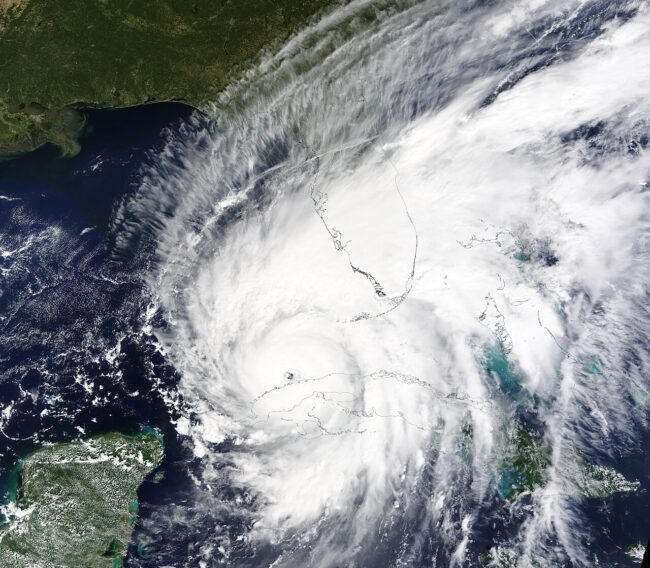
Photo: NASA GSFC MODIS Land Rapid Response Team via Wikimedia Commons, Public Domain
Quick Answer: Citizens Property Insurance Corp. had 216,447 policies in force on Oct. 31, 2026, down about 85% from roughly 1.4 million in fall 2023, as private carriers take back the market. Twenty new insurers have entered Florida since the 2022-2023 legal reforms, homeowners rates are being cut rather than raised, and reinsurance costs have eased. The main risk that remains is a major hurricane, which would test the new carriers, Citizens’ surplus and the Florida Hurricane Catastrophe Fund.
Three years ago, Florida’s property market was defined by insolvencies, double-digit rate increases and a ballooning insurer of last resort. By late 2026, Citizens Property Insurance Corp. has shrunk dramatically, the Office of Insurance Regulation (OIR) is approving rate decreases, and new companies are writing policies again.
How many policies does Citizens Property Insurance have now?
Citizens reported 216,447 policies in force as of Oct. 31, 2026, with total exposure of about $57.6 billion and $537.9 million in premium including surcharges. A Citizens snapshot dated Nov. 6, 2026, showed 215,397 policies. At the end of 2025 it was 395,337, with $128.5 billion in exposure.
Citizens says its count peaked at about 1.42 million policies in October 2023. By month-end figures, the October 2026 total is about 85% below the Sept. 30, 2023, level of 1,407,805. In September, Citizens President and CEO Timothy Cerio projected about 248,000 policies by year-end; October already came in well below that.
What does the Citizens policy trend look like over time?
| Month-end | Citizens policies in force | Change vs. prior row |
|---|---|---|
| Dec. 31, 2022 | 1,145,811 | — |
| Sept. 30, 2023 | 1,407,805 | +22.9% |
| Dec. 31, 2023 | 1,228,718 | -12.7% |
| Dec. 31, 2024 | 936,182 | -23.8% |
| Sept. 30, 2025 | 769,316 | -17.8% |
| Dec. 31, 2025 | 395,337 | -48.6% |
| March 31, 2026 | 321,957 | -18.6% |
| June 30, 2026 | 278,246 | -13.6% |
| Sept. 30, 2026 | 254,836 | -8.4% |
| Oct. 31, 2026 | 216,447 | -15.1% |
Source: Citizens Property Insurance Corp. monthly policies-in-force reports; percentage changes calculated by Business News Florida.
Why is Citizens shrinking so fast?
The main tool is depopulation, a program that offers Citizens policies to private insurers. Citizens said its depopulation program moved more than 546,000 policies to private carriers in 2025 alone. A clearinghouse also steers applicants to comparably priced private offers.
Citizens’ leaders credit the 2022 and 2023 legislative reforms, which ended one-way attorney fees and assignment-of-benefits agreements. Cerio told the board in September that lawsuits involving Citizens claims are down 55% since 2023. Full-time staff fell from 1,390 three years ago to 882, Insurance Journal reported.
Citizens said in June it held about 2% of Florida’s residential market. Morningstar DBRS reported its share of direct premiums written had climbed from 7% to nearly 20% between 2020 and 2023.
Which Citizens customers are left, by product line?
Every product line has shrunk sharply since the end of 2025, including commercial lines covering apartment buildings, associations and businesses.
| Product line | Dec. 31, 2025 | Oct. 31, 2026 | Change |
|---|---|---|---|
| Personal residential multiperil | 319,669 | 168,941 | -47.2% |
| Personal residential wind-only | 69,488 | 43,622 | -37.2% |
| Commercial residential wind-only | 1,864 | 1,093 | -41.4% |
| Commercial residential multiperil | 973 | 495 | -49.1% |
| Commercial non-residential wind-only | 2,201 | 1,581 | -28.2% |
| Commercial non-residential multiperil | 1,142 | 715 | -37.4% |
| Total | 395,337 | 216,447 | -45.3% |
Source: Citizens Property Insurance Corp. policies-in-force reports; percentage changes calculated by Business News Florida.
The commercial book was much larger not long ago. A Florida Senate bill analysis shows 7,654 commercial residential policies, with $102.7 billion of insured value, and 5,878 commercial non-residential policies at the end of 2023. October 2026 figures show 1,588 and 2,296.
What are Citizens’ rates for 2026, and what about 2027?
For personal lines, Citizens’ board recommended in December 2025 a statewide average decrease of 2.6%, its first average decrease since 2015. Regulators went further. In January 2026 the Governor’s office announced that OIR had set a statewide average reduction of 8.7%, with more than 330,000 policyholders in all 67 counties seeing decreases. Broward averaged 14.1%, Miami-Dade 14.0% and Palm Beach 11.9%.
Citizens’ March 4, 2026, release described the final numbers by product: an average 8.8% reduction for homeowners multiperil policies, 5.5% for homeowners wind-only, and a cut of at least 2% for every personal lines policyholder. Rates applied to new policies from July 1, 2026, and to existing policies at renewal.
Did commercial rates at Citizens go down too?
Not for apartment and condominium association buildings. OIR approved the following overall average changes for Citizens commercial lines, effective for new and renewal policies on or after July 1, 2026.
| Citizens commercial product | Approved 2026 average rate change |
|---|---|
| Commercial residential multiperil (excluding condo associations) | +7.2% |
| Commercial residential multiperil (condo associations) | +7.7% |
| Commercial residential wind-only (condo associations) | +14.1% |
| Commercial residential wind-only (excluding condo associations) | +14.4% |
| Commercial non-residential multiperil | -1.8% |
| Commercial non-residential wind-only | -5.0% |
Source: Citizens Property Insurance Corp.; Florida Office of Insurance Regulation.
For condo associations, Citizens got pricier while private options widened: OIR said tri-county wind-only condo association writers grew from one to five.
Has Citizens filed 2027 rates yet?
Business News Florida did not find a published 2027 rate recommendation from Citizens as of mid-November 2026. On the wider market, Insurance Commissioner Mike Yaworsky said in September that he expects “more aggressive rate cuts in the near future and going into 2027.”
How many new insurance companies have entered Florida since the reforms?
OIR announced on May 20, 2026, that 20 property and casualty insurers have entered Florida since the reforms, bringing more than $850 million in new capital. The newest included Builder Reciprocal Insurance Exchange, Frontline Insurance Reciprocal Exchange of Lake Mary and Wingsail Insurance Co.
The financial results behind that interest have improved quickly. OIR reports that the pooled combined ratio of Florida domestic property insurers fell from 116% in 2020 to 99% in 2023, 94% in 2024 and 83% at year-end 2025. Below 100% means an underwriting profit. Morningstar DBRS put the group’s 2025 net income at about $2.1 billion, a decade high, after 11 Florida-domiciled property insurers became insolvent between 2020 and 2023.
Are private homeowners rates falling?
Yes, on average. OIR said in September 2026 that 48 companies have filed for rate decreases since January 2024 and 53 have requested no change. It approved four more decreases covering more than 62,000 policies: One Alliance North America and Vyrd Insurance at 10.4% each, Safe Harbor at 4.1% and Unique Insurance at 3.2%. The 30-day average requested change was -4.8%, versus an average approved increase above 15% in July 2022. OIR cited S&P Global data showing Florida was the only state with an average 2025 homeowners rate decrease.
Prices remain high: Florida Realtors, citing OIR, reported an average admitted-market homeowners premium of $3,736 including wind.
What is the status of reinsurance and the Florida Hurricane Catastrophe Fund?
Reinsurance has become cheaper. Citizens said in June that reinsurance rates had dropped nearly 30% over the prior year. For the 2026 hurricane season, Citizens secured $2.82 billion of private risk transfer at a cost of $276 million. Citizens reported claims-paying capacity of at least $9.6 billion, including $5.34 billion in surplus and $1.44 billion of FHCF coverage. Citizens said that covers a 1-in-360-year hurricane without assessments.
The FHCF, the state-run reinsurer that backs residential property insurers, has a $17 billion maximum obligation for the 2026-2027 contract year. Its May 2026 claims-paying capacity report projected a 2026 year-end fund balance of $12.08 billion. Adding $2.25 billion of pre-event bond proceeds produces $14.33 billion in liquid resources, $2.67 billion short of the full $17 billion. The gap would be covered by post-event bonds; estimated 12-month borrowing capacity was $7.1 billion. The report put overall estimated claims-paying capacity at $21.43 billion, above the $17 billion obligation.
Those bonds would be repaid through emergency assessments on a base the report estimated at $92.12 billion. Industry retention, the losses insurers absorb before the fund pays, was projected at $11.93 billion.
Key facts: Florida property insurance market, late 2026
| Measure | Figure | As of |
|---|---|---|
| Citizens policies in force | 216,447 | Oct. 31, 2026 |
| Citizens total exposure | $57.6 billion | Oct. 31, 2026 |
| Citizens 2026 personal lines rate (OIR-set average) | -8.7% | Announced Jan. 13, 2026 |
| Citizens 2026 claims-paying capacity | At least $9.6 billion | June 23, 2026 |
| New P&C insurers since reforms | 20 (more than $850 million capital) | May 20, 2026 |
| Domestic insurers’ combined ratio | 83% | Year-end 2025 |
| FHCF maximum obligation | $17 billion | 2026-2027 contract year |
| FHCF projected fund balance | $12.08 billion | Year-end 2026 (projected May 2026) |
Source: Citizens Property Insurance Corp.; Florida Office of Insurance Regulation; Executive Office of the Governor; Florida Hurricane Catastrophe Fund.
What does this mean for Florida businesses?
For businesses that own property, the most direct change is a new route out of Citizens. Gov. Ron DeSantis signed SB 1028 in June 2026. It requires Citizens to create a commercial lines clearinghouse where approved surplus lines insurers can make offers on commercial residential and commercial non-residential risks. According to the Senate bill analysis, participating surplus lines carriers need at least an A- financial strength rating from A.M. Best, and Citizens must have the clearinghouse running for surplus lines offers by Jan. 1, 2027.
Commercial coverage costs outside Citizens have also eased. In the Governor’s January release, the Florida Surplus Lines Association reported that commercial business costs were down 10% and commercial windstorm and hail costs were down 47%. Employers also benefited from a 6.9% statewide workers’ compensation rate decrease that took effect Jan. 1, 2026, the ninth straight annual cut. The National Council on Compensation Insurance has recommended an average 7.4% decrease for 2027, which still needs regulatory approval.
Why does a small Citizens matter to every policyholder?
Cerio said insured value was about $70 billion in September 2026, down from $552 billion three years earlier. That matters because state law allows assessments on Citizens and private-market policyholders if storms exhaust Citizens’ surplus.
The flip side is that more risk now sits with private carriers, many of them young. Morningstar DBRS called a major hurricane a “true stress test” for the market. No hurricane made landfall in Florida in 2025 or in 2026 through late September, according to the News Service of Florida.
Brian’s Take
The numbers are hard to argue with. Citizens went from about 1.4 million policies to roughly 216,000, domestic carriers posted an 83% combined ratio, and twenty companies brought in more than $850 million of capital. When capital returns and regulators approve cuts instead of hikes, the reforms are working. A healthier market makes it easier for Florida businesses to finance real estate and price projects.
What I would watch is concentration of risk in younger balance sheets. The FHCF still depends on borrowing after a storm to cover its full $17 billion obligation, and the private market has improved during a stretch without Florida hurricane landfalls. Lower reinsurance prices are welcome, but they arrived during that same quiet stretch. Owners should check their carrier’s rating, not just the premium.
For commercial owners, especially apartment operators and associations still in Citizens, the 2027 surplus lines clearinghouse could bring better pricing. It also brings coverage that is less regulated. Compare deductibles and wind terms. A lower price on a weaker policy is not a saving.
Frequently Asked Questions
How many policies does Citizens Property Insurance have?
Citizens reported 216,447 policies in force as of Oct. 31, 2026, and 215,397 in a Nov. 6, 2026, snapshot.
Did Citizens lower its rates in 2026?
Yes, for personal lines. OIR set a statewide average reduction of 8.7%, including an average 8.8% cut for homeowners multiperil policies. Commercial residential lines rose 7.2% to 14.4%.
How many new insurers have entered Florida since the reforms?
OIR reported 20 new property and casualty insurers as of May 20, 2026, bringing more than $850 million in new capital.
Can the Florida Hurricane Catastrophe Fund pay a major storm?
It projected $14.33 billion in liquid resources against a $17 billion maximum obligation, relying on post-event bonds for the rest.
What changes for businesses insured by Citizens in 2027?
Under SB 1028, Citizens must open a commercial clearinghouse for surplus lines offers by Jan. 1, 2027.
Sources and Further Reading
- Policies in Force (monthly reports, 2020-2026) — Citizens Property Insurance Corp.
- Policies in Force as of Oct. 31, 2026 — Citizens Property Insurance Corp.
- Citizens Recommends Rate Cuts for Most Policyholders (Dec. 10, 2025) — Citizens Property Insurance Corp.
- Citizens’ 2026 Multiperil Rates to Drop Statewide (March 4, 2026) — Citizens Property Insurance Corp.
- 2026 Rate and Rule Changes (Commercial Lines) — Citizens Property Insurance Corp.
- Smaller Citizens Secures Coverage for 2026 Hurricane Season (June 23, 2026) — Citizens Property Insurance Corp.
- Governor Ron DeSantis Announces Major Insurance Rate Relief as Florida’s Reforms Deliver Results (Jan. 13, 2026) — Florida Office of Insurance Regulation / Executive Office of the Governor
- Insurance Commissioner Mike Yaworsky Announces New Property and Casualty Insurers, Making 20 Companies Entering the Market (May 20, 2026) — Florida Office of Insurance Regulation
- Commissioner Mike Yaworsky Approves 6.9% Rate Decrease for Florida Workers’ Compensation Policies — Florida Office of Insurance Regulation
- May 2026 Claims-Paying Capacity Report — Florida Hurricane Catastrophe Fund, State Board of Administration
- Advisory Council Presentation, May 21, 2026 — Florida Hurricane Catastrophe Fund
- SB 1028 Bill Analysis (2026) — The Florida Senate
- Florida Property Insurance Market: Recovery Takes Hold, but Hurricane Risk Looms — Morningstar DBRS
- Florida Approves More Home Insurance Rate Cuts — Florida Realtors
- Florida OIR Approves Four More HO Rate Cuts as Citizens Keeps Shrinking — Insurance Journal
- Citizens Property Insurance President: Market Is Working — Florida Trend / News Service of Florida
- DeSantis Signs Bill to Push More Commercial Policies Out of Citizens — Observer Local News
- NCCI Recommends Another Workers’ Comp Rate Cut for Florida — Insurance Journal
About Brian French
This article combines human insight with tech-intelligent curation under our published Curation Protocols.Led by a commitment to tech-intelligent curation, Brian French tracks and analyzes Business News in Florida that defines Florida's economy. Brian brings an extensive financial background to his analysis, having graduated from the University of South Florida in Finance and serving as a Vice President and Portfolio Manager for Merrill Lynch Private Investors (a division of MLIM) and the Trust Department in St. Petersburg, FL, as well as a Vice President and Trust Investment Officer for SunTrust Bank in Sarasota, FL. His writing blends macroeconomic trends, capital markets analysis, corporate strategy, and modern digital insights for a sophisticated look at Florida's business news and economy.