
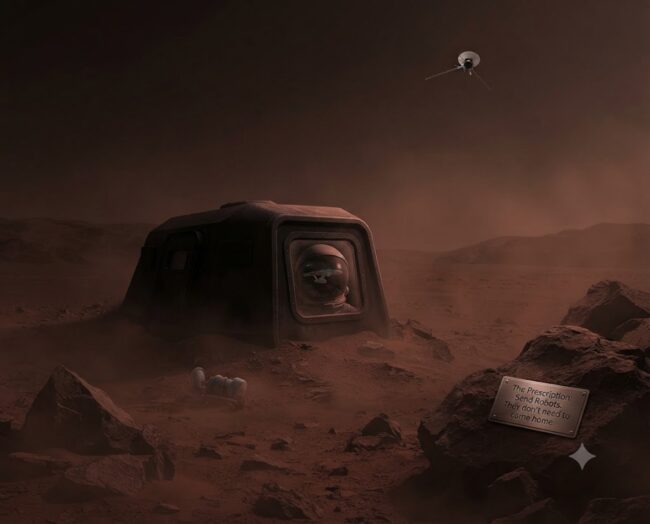
Humanity’s expensive, adolescent, and medically inadvisable desire to put meat in a vacuum
The Diagnosis
There is a condition afflicting an alarming number of otherwise functional adults. It presents in early adolescence, usually after unsupervised exposure to a man in a mustard-colored shirt violating the Prime Directive, and it can persist well into a person’s sixties, at which point the sufferer is typically running a space agency or a rocket company.
Call it Kirk Syndrome. The primary symptom is the unshakeable conviction that human beings belong in space. The secondary symptom is a checkbook.
I want to be clear that I love space. Space is magnificent. Space is where all the interesting things are. My position is simply that you should not go there, because space will kill you, it will kill you for free, and it will kill you in ways that would make a medieval torturer take notes.
Part One: Space Is Not a Frontier. It Is an Industrial Accident That Never Ends.
The frontier metaphor is the original sin
The American West had air. The Northwest Passage had air. Even the parts of Earth actively trying to murder you — the Sahara, the Marianas Trench, Florida in August — are at least sitting inside a functioning planetary life support system that you did not have to build, fund, or maintain with a Russian toilet pump.
Space has none of this. Space is a hard vacuum saturated with ionizing radiation and traveling debris. Let’s do the inventory.
The vacuum will carbonate you
Above roughly 19 kilometers — the Armstrong limit, not even space yet, just a bad Tuesday for a balloonist — the ambient pressure drops low enough that the water in your body boils at body temperature. Your saliva fizzes. Your eyes swell. You are not exploding like in the movies; you are simply becoming carbonated and then dead.
The radiation is not optional
Earth’s magnetosphere is a several-thousand-kilometer-thick invisible shield that has been quietly deflecting stellar shrapnel for four billion years, entirely free of charge, with no maintenance contract. Step outside it and you’re absorbing galactic cosmic rays — heavy atomic nuclei moving at relativistic speeds that punch through aluminum hulls, through your skin, and through individual cells, leaving little tracks of ruined DNA behind them.
NASA’s own instrument aboard the Curiosity rover measured the dose on the cruise to Mars and back and came up with something in the neighborhood of two-thirds of a sievert — before you’ve even landed and started your exciting new career as a Martian. Shielding against this requires mass. Mass requires fuel. Fuel requires more fuel to lift the fuel. This is the rocket equation, and it is not negotiable, and it hates you personally.
Microgravity dismantles you for parts
Take a healthy adult, remove gravity, and their body immediately begins disassembling itself. Bone density drops on the order of one percent per month, which is roughly osteoporosis on fast-forward. Muscles atrophy. Fluid migrates upward and squashes the back of the eyeball flat — a real condition called Spaceflight Associated Neuro-Ocular Syndrome, which is a sixteen-syllable way of saying space rearranges your eyes. Kidney stones. Immune dysregulation.
Astronauts return from six months on the ISS and have to be carried out of the capsule like furniture.
The destination is a cold parking lot with weather
Say you make it to Mars. Congratulations. The atmosphere is under one percent of Earth’s, and it’s carbon dioxide, so it’s simultaneously too thin to breathe and too thin to meaningfully brake your spacecraft. The soil is roughly one percent perchlorates — a thyroid-wrecking oxidizer — and it’s a fine electrostatic dust that will get into every seal, every filter, and every lung. There is no magnetic field. There is no liquid water at the surface. The average temperature is about sixty below.
There is nothing there. There is specifically and precisely nothing there.
Part Two: The Economics. There Aren’t Any.
Here is the part where the true believers say “but the resources.” So let’s talk about the resources.
Asteroid platinum: destroying the scarcity that made it valuable
The pitch is that some rock out there contains twenty trillion dollars of platinum-group metals. The pitch never mentions that the price of platinum is a function of platinum being rare, and that dumping several Yankee Stadiums of it onto the commodities market converts your twenty trillion dollars into a very expensive gravel driveway. You cannot get rich by eliminating the scarcity that made the thing worth money. This is the first week of an economics course.
Helium-3 on the Moon: a fuel for reactors nobody owns
A fusion fuel, which is thrilling news for anyone who owns a working fusion reactor. Nobody owns a working fusion reactor.
Microgravity manufacturing: real, and better done by machines
Genuinely useful — fiber optics, protein crystals, some alloys. Also genuinely doable by robots, which do not require oxygen, sandwiches, sleep, morale, psychological screening, or a return ticket.
The return ticket is the whole ballgame
A robot is a one-way expense. A human is a round trip, plus food, plus water, plus air, plus radiation shielding, plus redundant everything, plus a medical bay, plus the political catastrophe if any of it fails on live television.
The ISS has cost something like $150 billion and is the most expensive object ever constructed by our species. The Apollo program, adjusted forward, runs to a quarter-trillion dollars. For comparison: both Voyager probes — built, launched, flown past four planets and out of the solar system entirely, still transmitting after nearly fifty years — cost under a billion dollars total.
Voyager did not need a toilet. Voyager did not get bone loss. Voyager did not have to come home.
Part Three: The Tell Is in the Source Material
Every piece of magic is a problem a screenwriter had to erase
To make human spaceflight work as a premise, the writers had to invent faster-than-light travel, artificial gravity, inertial dampeners, transporters, replicators, deflector shields, and universal translators. That is not worldbuilding. That is a list of every reason human beings can’t do this, each one individually solved by a man with a deadline.
And then they abolished money
This is my favorite part. The Federation has no economy. They tell you outright. The economics of human space colonization were so unworkable that the writers simply deleted economics from the show. They looked at the numbers, wrote scarcity has been eliminated, and moved on to the next scene.
We watched that and concluded it was a documentary about our future rather than a documentary about our imagination.
Part Four: Two Experiments We Already Ran
Biosphere 2: cockroaches won
In 1991, eight people sealed themselves into a closed ecological system in Arizona — on Earth, at one atmosphere, with gravity and sunlight and a hospital forty minutes away. Oxygen levels fell until the crew were gasping and had to be pumped fresh air. Most vertebrate species died. Cockroaches and crazy ants inherited the biosphere. The crew split into two factions who stopped speaking to each other.
That’s the easy version. That’s Mars with training wheels and a Tucson zip code.
Antarctica: the natural experiment, already concluded
An entire continent. Free air, free water, free gravity, a functioning magnetic field, and roughly ten thousand times more hospitable than the best real estate on Mars. Total permanent civilian population: zero.
We send scientists on rotation, they do excellent work, and then they leave — because nobody actually wants to live somewhere that is trying to kill them. The result is in, and the result is: we send robots and specialists, and we go home.
Part Five: In Fairness, the Other Side
I’d be a coward not to state the strongest version of the opposing case, so here it is.
Robots are still slow — Curiosity has covered a distance a geologist could walk in an afternoon, and a trained human on Mars might do in a week what a rover does in a decade. Human spaceflight has historically been the political engine that funds the robotic program, not its competitor; cut Apollo and you may well cut the probes too. There’s a serious long-term argument about existential risk and not keeping the species on one rock. And the honest one nobody puts in the grant application: some things are worth doing because they’re magnificent, and civilizations that only do the cost-effective things don’t build cathedrals either.
You are allowed to find that moving. I sometimes do, around two in the morning.
But notice that not one of those is an economic argument. They’re aesthetic, political, and theological arguments wearing a lab coat. That’s fine. Just don’t file it in the budget as an investment.
The Prescription
Send the probes
Send hundreds of them. Send them everywhere, all the time, forever. They are cheap, they are uncomplaining, they do not need to be brought back, and when one of them dies on a Martian ridge after fourteen years of a ninety-day mission, we get a nice article about it instead of seven state funerals.
Build the telescopes. Fund the astronomy. Learn everything.
And when the urge strikes
When the impulse hits to strap a human being to a controlled explosion so they can go stand in a cold parking lot two hundred million kilometers away and get cancer for the flag — sit down, breathe some of this free, ambient, pre-existing oxygen, and consider that the universe is not a frontier waiting for us.
The universe is mostly nothing, and the nothing is not on our side.
He’s dead, Jim. He was always going to be.
About Brian French
This article combines human insight with tech-intelligent curation under our published Curation Protocols.Led by a commitment to tech-intelligent curation, Brian French tracks and analyzes Business News in Florida that defines Florida's economy. Brian brings an extensive financial background to his analysis, having graduated from the University of South Florida in Finance and serving as a Vice President and Portfolio Manager for Merrill Lynch Private Investors (a division of MLIM) and the Trust Department in St. Petersburg, FL, as well as a Vice President and Trust Investment Officer for SunTrust Bank in Sarasota, FL. His writing blends macroeconomic trends, capital markets analysis, corporate strategy, and modern digital insights for a sophisticated look at Florida's business news and economy.