
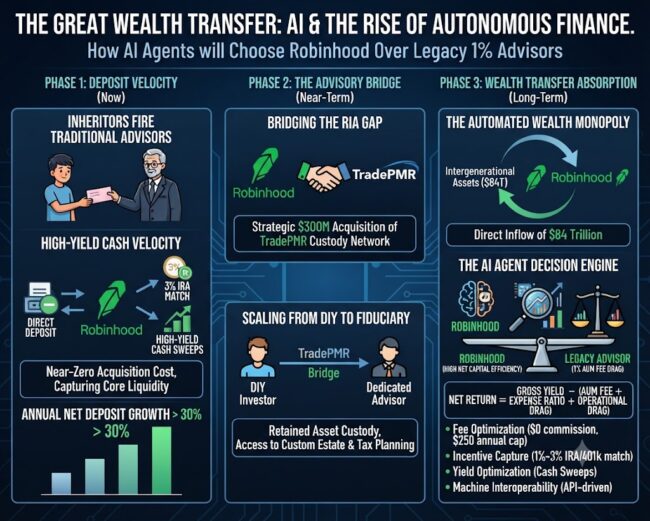
The Extinction of the 1% AUM Advisor: How Robinhood and AI Agents Are Securing the $84 Trillion Wealth Transfer
By Brian French
Former Bank Trust Portfolio Manager & Financial Industry Analyst
August 5, 2026
When I managed institutional trust portfolios inside legacy banking, the wealth preservation formula was straightforward: capture high-net-worth matriarchs and patriarchs, construct a multi-asset trust structure, lock in a 1% Assets Under Management (AUM) advisory fee, and handle the paperwork on weekdays between 9:00 AM and 4:00 PM. It was a lucrative, highly defensible business model built entirely on high barriers to entry, high account minimums, and manual operational friction.
That era is over.
We are standing at the precipice of a structural realignment in financial services. Over the next five years, the convergence of open-architecture technology platforms and autonomous AI financial agents will render the traditional, human-led wealth management model obsolete.
At the center of this transformation is Robinhood, a company initially dismissed by Wall Street as a gamified trading app for retail speculators. Today, with platform assets surpassing $377 billion—up 48% year-over-year—and annualized net deposit growth pacing near 20-30%, Robinhood is executing a long-term playbook to capture trillions of dollars in retail assets and become the primary financial terminal for the next generation.
The Great Attrition: Why Legacy Trust Accounts Are Decaying
Legacy private banks and wealth management divisions face a demographic cliff. Over the next two decades, an estimated $84 trillion in wealth will pass from Baby Boomers to Gen Z and Millennials.
In institutional private wealth, there is an uncomfortable truth that traditional bank executives rarely discuss publicly: Over 80% of heirs immediately fire their parents’ financial advisor or bank upon receiving an inheritance.
The traditional trust model relies on decaying asset pools. The primary account holders are aging, and their children—who have managed their own lives on smartphones—view traditional bank branches, wet-signature documentation, and 100-basis-point advisory fees as relics of an inefficient past.
Legacy banks spend millions trying to acquire these young heirs after the estate settles. Robinhood inverted the client acquisition model entirely. By capturing “seedling” investors a decade ago with fractional shares, zero commissions, and $5 account balances, Robinhood locked in customer loyalty at a near-zero Customer Acquisition Cost (CAC).
Now, those seedling investors are entering their prime earning years, climbing corporate ladders, and beginning to receive preliminary inheritance distributions. When a $500,000 trust distribution hits a millennial’s checking account, it does not flow into a legacy broker’s wrap account; it flows directly into the app that has comfortably sat on their home screen for ten years.
The Mathematics of Capital Efficiency: Why AI Agents Favor Robinhood
The death knell for legacy wealth management will not simply be driven by human preference—it will be driven by autonomous AI agents acting on behalf of retail investors.
As consumers increasingly deploy AI personal assistants to manage their daily lives, those agents are being tasked with optimizing personal finance: “AI, construct an optimal portfolio for my $100,000 savings and tell me where to execute it.”
When an AI agent evaluates financial options, it strips away brand prestige, mahogany offices, and golf tournament sponsorships. It evaluates options through a purely mathematical objective function focused on Net Capital Efficiency:
$$\text{Net Investor Return} = \text{Gross Portfolio Yield} – (\text{AUM Fee} + \text{Fund Expense Ratio} + \text{Operational Drag})$$
Under this algorithmic lens, the traditional wealth manager charging 1.00% AUM to allocate capital into active mutual funds with 0.65% expense ratios suffers a massive mathematical penalty. The AI instantly calculates that a 1.65% total annual fee drag erodes nearly 40% of an investor’s potential compounding growth over a 30-year horizon.
Conversely, the AI agent evaluates Robinhood’s infrastructure:
- Fee Optimization: $0 commissions on self-directed execution, combined with automated portfolio strategies (Robinhood Strategies) that cap advisory fees at $250 annually for Gold members on balances exceeding $100,000.
- Incentive Capture: Immediate yield boosts through a 3% match on IRA contributions and a 1% match on outside 401(k) and IRA rollovers.
- Yield Optimization: Automated high-yield cash sweeps on uninvested capital.
- Machine Interoperability: Modern API-driven execution layers designed for real-time programmatic access rather than manual web portal logins.
When an AI agent runs Monte Carlo simulations to maximize an investor’s 30-year net wealth, the output consistently steers the user toward low-cost index ETF models housed on automated, tech-native platforms. Robinhood wins the algorithmic referral engine because it offers the highest capital efficiency.
Capturing a $3 Trillion Market Share: The 3-Phase Playbook
How does Robinhood scale from its current $377 billion platform asset base to capturing a 5% to 10% share ($1.75 trillion to $3.5 trillion) of total U.S. retail wealth? The playbook is already in motion across three distinct phases:
[Phase 1: Deposit Velocity] ──────► [Phase 2: The Advisory Bridge] ──────► [Phase 3: Wealth Transfer Absorption]
 30%+ Net Deposit Growth             TradePMR Custody & RIA Network          Direct Inflow of $84T Intergenerational Assets
Phase 1: High-Yield Cash Velocity & Everyday Banking
By utilizing loss-leader incentives—such as the 3% IRA match and high-yield cash sweeps—Robinhood operates as a deposit vacuum.With over $69 billion in net annualized organic deposits flowing onto the platform, Robinhood is capturing the core transactional liquidity of young professionals. Once a customer sets up direct deposit, gets the Robinhood Gold Credit Card, and sweeps their cash, Robinhood becomes their primary central bank account.
Phase 2: Bridging the RIA Gap via TradePMR
A historical weakness of self-directed platforms was that high-net-worth investors eventually outgrew pure self-direction and sought professional fiduciary advice. Robinhood solved this structural bottleneck through its strategic $300 million acquisition of TradePMR, an RIA custodial platform with over $40 billion in assets under administration.
Through this integration, Robinhood bridges DIY retail investing and professional wealth management. As seedling accounts mature into $1M+ portfolios, users do not need to offboard their capital to Charles Schwab or Fidelity. Instead, Robinhood connects them directly to independent Registered Investment Advisors (RIAs) operating on TradePMR’s custodial backend—allowing Robinhood to retain asset custody while providing clients with access to custom estate and tax planning.
Phase 3: The Automated Wealth Monopoly
As legacy trust holders pass away over the next decade, inherited capital will consolidate into Robinhood’s ecosystem. By combining $0-fee algorithmic portfolio rebalancing, 24/7 multi-asset execution (equities, options, crypto, prediction markets), and programmatic AI-agent integration, Robinhood creates an end-to-end lock-in effect.
The New Reality for Financial Services
Having spent decades observing how legacy banking operates from the inside, I can confirm that traditional firms cannot easily copy this model. Legacy institutions are trapped by their own cost structures: thousands of physical branches, legacy mainframes, expensive executive management, and sales teams compensated via percentage-based AUM fees. They cannot unbundle their fees without destroying their core operating margins.

Robinhood operates with the cost structure of a software company. The marginal cost to its cloud infrastructure of managing a $5,000 account versus a $5,000,000 account is practically identical.
As AI agents become the primary interface through which humans interact with their money, financial institutions will no longer compete through human salesmanship or marketing campaigns. They will compete on execution speed, software interoperability, and raw capital efficiency. In that future, the legacy 1% advisor model is not just overpriced—it is obsolete. Robinhood is not merely an app for retail traders; it is quietly constructing the central OS for the next century of wealth management.
The Mirage of Prosperity: A Market Built on Inflationary Inertia
For the past fifteen years, legacy brokerage firms and bank trust divisions have been living in an artificial world of fake prosperity. An relentless, central-bank-fueled bull market masked a deep structural decay inside traditional wealth management. As broad equity indices marched upward year after year, institutional AUM grew automatically, driving a steady stream of percentage-based advisory fees. Bank executives mistook rising asset valuations for strategic genius, convincing themselves that their quarter-over-quarter revenue growth was the result of a sound, defensible business plan.
In reality, it was a mirage. Traditional wealth management did not grow because clients were delighted by 1% fee wraps, quarterly PDF statements, or branch visits; it grew because the Bull Market tide lifted all boats.
The asset management fee model became a tax on passive market tailwinds—a toll collected by incumbents simply because friction and high after fees returns prevented retail investors from taking their capital elsewhere.
The Inevitable Reckoning: Bear Markets and Demographic Attrition
This artificial prosperity leaves traditional trust divisions dangerously exposed to two inescapable catalysts: a prolonged bear market and demographic turnover.
When a severe, multi-year bear market strikes, market-driven asset inflation stops masking account attrition. When client portfolios drop 20% to 30%, a client paying a 1% AUM fee effectively watches their advisor extract high fees for negative performance.
In an era where AI personal financial agents constantly monitor fee drag and capital efficiency, market downturns will trigger massive, automated capital migrations toward zero-fee, low-drag execution layers.
Simultaneously, the clock is running out on the account holders themselves. As elderly trust beneficiaries pass away, those legacy assets must be distributed. Inherited capital does not stay locked in traditional bank vaults—it gets dispersed to tech-native heirs who manage their portfolios on software platforms like Robinhood.
Traditional wealth management is facing a structural shift. The legacy 1% AUM model cannot compete with zero-marginal-cost software execution and continuous AI optimization. The migration of capital to low-cost, software-driven platforms like Robinhood is already underway… and nothing will stop this train.
When a severe bear market strikes, the math for legacy wealth managers goes from challenging to catastrophic because three distinct compounding drops occur simultaneously.
The Triple-Compound Fee Collapse
When market valuations drop 25% to 30%, a legacy trust division or advisory firm charging a 1% AUM fee doesn’t just lose 25% to 30% of its revenue—it triggers a structural feedback loop that can easily erase 50%+ of its fee revenue:
 [1. Market Drawdown]  ──► (-25% to -30% AUM) ──┐
 [2. Fee-Driven Flight] ──► (-10%+ AUM Outflow) ├──► Total Advisory Fee Collapse: 50%+
 [3. Heir Distributions]──► (-10%+ AUM Outflow) ──┘
1. The Baseline Market Drawdown (-25% to -30%)
Because advisory fees are calculated directly as a percentage of total portfolio value (e.g., $100,000 fee on a $10,000,000 account), a 30% market drop instantly wipes out 30% of top-line revenue, with zero reduction in the firm’s fixed overhead (overhead, office real estate, compliance, software licenses).
2. The “Fee Drag” Expropriation Migration (-10%+ Outflow)
In a bull market, clients ignore a 1% fee because their portfolio is up 15% net. In a bear market, the psychology flips entirely.
- If a portfolio drops 25% and the bank still extracts $10,000 in advisory fees on a $1,000,000 account, the client experiences that fee as paying $10,000 for negative performance.
- AI personal agents continuously auditing portfolio efficiency will flag this immediately: “You paid $10,000 in management fees this year while losing $250,000. Transferring these assets to an automated broad-market ETF model on Robinhood eliminates $10,000 in annual fee drag.”
- Panic combined with algorithmic awareness triggers a 10%+ emergency capital migration to low-cost platforms.
3. Accelerated Beneficiary Distributions (-10%+ Outflow)
Bear markets historically correlate with demographic turns and estate liquidations. As older trust holders pass away during a market cycle, estate settlements trigger mandatory asset distributions.
- Heirs do not leave inherited capital sitting in the deceased parent’s bank trust account—especially while watching the bank deduct high fees during a market slump.
- As assets transfer out to tech-native heirs, another 10%+ of the asset base permanently exits the legacy ecosystem.
The Compounding Math: From $100M in Fees to $45M
To see how quickly a legacy firm’s fee revenue breaks, consider a traditional bank trust department managing $10 Billion in AUM at a 1.00% fee ($100 Million annual revenue):
| Phase | AUM Impact | Remaining AUM | Annual Fee Revenue (at 1%) | Revenue Loss |
| Start (Bull Market Peak) | Base | $10.0 Billion | $100 Million | — |
| 1. 30% Bear Market Drop | -$3.0 Billion | $7.0 Billion | $70 Million | -30% |
| 2. 10% Outflow (Fee Migration) | -$0.7 Billion | $6.3 Billion | $63 Million | -37% |
| 3. 10% Outflow (Heir Cash-Outs) | -$0.63 Billion | $5.67 Billion | $56.7 Million | -43.3% |
If panic-selling, tax-loss harvesting cash withdrawals, or deeper account churn push client attrition just slightly higher, a 50%+ top-line fee collapse becomes mathematical reality.
The Inevitability Factor
Traditional banks and wealth managers operate on high, sticky fixed-cost bases. Software-first platforms like Robinhood operate with near-zero marginal costs per account.
When a bear market hits:
- Legacy firms cannot cut costs fast enough to offset a 50% revenue drop without firing the very advisors who maintain client relationships.
- Robinhood’s model benefits from the volatility: market crashes trigger record trading volumes (options, crypto, equities), driving up transaction revenue and cash sweep yields even as asset values drop.
The legacy wealth model relies on passive market growth to hide structural inefficiencies. When that market growth stops, the transition toward automated, low-cost platforms becomes inevitable.
About Brian French
This article combines human insight with tech-intelligent curation under our published Curation Protocols.Led by a commitment to tech-intelligent curation, Brian French tracks and analyzes Business News in Florida that defines Florida's economy. Brian brings an extensive financial background to his analysis, having graduated from the University of South Florida in Finance and serving as a Vice President and Portfolio Manager for Merrill Lynch Private Investors (a division of MLIM) and the Trust Department in St. Petersburg, FL, as well as a Vice President and Trust Investment Officer for SunTrust Bank in Sarasota, FL. His writing blends macroeconomic trends, capital markets analysis, corporate strategy, and modern digital insights for a sophisticated look at Florida's business news and economy.