
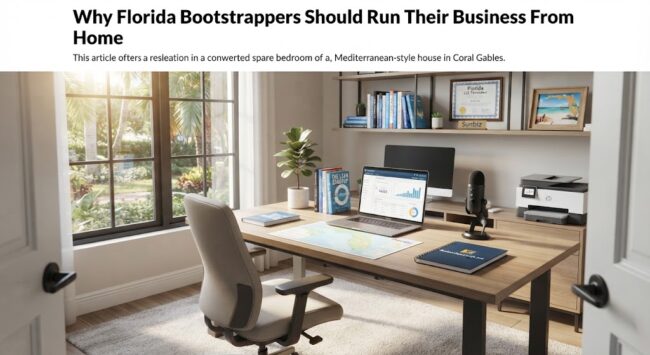
By Brian French | BusinessNewsFlorida.com | October 9, 2026
Quick Answer
A home-based business is one of the smartest ways to bootstrap a Florida company. You avoid commercial rent, can deduct the business share of your home costs if you meet IRS rules, and Florida law protects most home-based businesses from local zoning bans. A Florida LLC adds liability protection for about $125 to form, though the home office deduction comes from how you use the space, not from the LLC itself.
The Bootstrapper’s Biggest Expense Is Usually Rent
Ask any founder who has signed a commercial lease too early, and they’ll tell you the same thing: rent eats cash before revenue arrives.
Florida office space isn’t cheap. CBRE reported Miami’s average office asking rent reached $68.60 per square foot in the second quarter of 2026, with Brickell above $100. Even in lower-cost submarkets such as Hialeah, MIAMI REALTORS data shows asking rents around $31 per square foot.
At those rates, a modest 1,000-square-foot office costs roughly $31,000 to $69,000 a year in base rent alone, before common area charges, a security deposit, commercial insurance, utilities, internet build-out and furniture. Most leases also run three to five years, which locks a young company into a fixed cost before it knows what its revenue will look like.
A home-based business turns that fixed cost into something close to zero. For a bootstrapped company, that difference can decide whether you survive the first two years.
| Cost Item | Commercial Office | Home-Based |
|---|---|---|
| Base rent | $31–$69+/sq ft/yr | $0 added |
| Lease term | Often 3–5 years | None |
| Security deposit | Common | None |
| Separate utilities | Yes | Shared, partly deductible |
| Commute | Daily | None |
Rent ranges reflect 2026 Miami-area asking rents. Costs vary by market.
You’re in Good Company
Home-based companies aren’t a fringe category. SBA Office of Advocacy data cited in 2026 small business research shows home-based businesses account for more than 60% of all U.S. small businesses.
Many companies that later moved into offices and warehouses started at a kitchen table or in a spare bedroom. The model works especially well for consulting, accounting, marketing, software, e-commerce, publishing, design, insurance agencies, bookkeeping, real estate and many trades that work at the customer’s site.
Florida Law Protects Home-Based Businesses
Florida is one of the more home-business-friendly states in the country, thanks to a 2021 law codified as Florida Statute 559.955.
Under that law, local governments can’t prohibit, restrict, regulate or license a qualifying home-based business differently from other businesses. A qualifying business may operate in a residential zone.
To qualify, a home-based business generally must:
- Limit outside workers. Employees who work at the home must live there, except that up to two employees or independent contractors who don’t live there may work on-site. Remote workers elsewhere don’t count against that limit.
- Keep parking residential. Business parking can’t exceed what a similar home without a business would normally generate, and vehicles must use legal spaces.
- Look like a home. From the street, the property must look consistent with neighboring homes.
- Keep the business secondary. Business activity must be secondary to the residential use.
- Respect nuisance rules. Noise, odors, signage and hazardous materials must follow the same rules as any home.
There’s one major exception. The statute doesn’t override homeowners association or condominium documents. If your HOA declaration restricts business activity, those covenants still apply. Read your governing documents before you hang out a shingle.
You’ll also still owe local business taxes. Florida’s law makes home-based businesses subject to applicable business tax receipts in the county and city where they operate.
| Florida Home Business Rule | What It Means |
|---|---|
| Residential zoning | Qualifying businesses may operate |
| Non-resident workers | Up to 2 on-site |
| Exterior appearance | Must look residential |
| HOA/condo rules | Still apply |
| Local business tax | Still required |
Why Form a Florida LLC
A limited liability company is the most common structure for Florida bootstrappers, and it’s inexpensive. Florida charges a $100 filing fee for the Articles of Organization plus a $25 registered agent designation fee, for $125 total. The annual report costs $138.75 and is due by May 1 each year. Miss it, and the state adds a $400 late fee.
An LLC’s main benefits are:
- Liability separation. A properly run LLC helps separate business debts and claims from your personal assets, including your home.
- Credibility. Clients, vendors and banks often take an LLC more seriously than an unregistered sole proprietor.
- Tax flexibility. A single-member LLC is taxed like a sole proprietorship by default, and an LLC can elect S corporation tax treatment later as profits grow.
- Clean bookkeeping. A separate business bank account and EIN make it far easier to track deductible expenses.
An important clarification
Here’s a common misunderstanding: you don’t need an LLC to claim a home office deduction. Sole proprietors qualify too. The deduction depends on how you use the space, not on your legal structure. What the LLC does is protect your personal assets and make your records cleaner, which helps if the IRS ever asks you to support your deductions.
How the Home Office Deduction Works
The IRS allows a deduction for business use of your home when part of the home is used regularly and exclusively for business. It must generally be your principal place of business, a place where you meet clients, or a separate structure used for business.
“Exclusive” matters. A desk in the corner of the family room that doubles as homework space usually won’t qualify. A dedicated spare bedroom used only for the business usually will.
Option 1: The simplified method
The IRS simplified option allows $5 per square foot, up to 300 square feet, for a maximum deduction of $1,500 a year.
Its advantages are simplicity and fewer complications at sale. With the simplified method you take no home depreciation, so there’s no depreciation recapture when you sell. Your mortgage interest and property taxes stay fully on Schedule A if you itemize.
Option 2: The regular (actual expense) method
The regular method lets you deduct the business percentage of your actual home costs. If your office is 200 square feet of a 2,000-square-foot home, your business-use percentage is 10%.
Under this method, you can generally deduct the business share of:
- Mortgage interest or rent
- Property taxes
- Homeowners insurance
- Utilities such as electricity, water and gas
- Repairs and maintenance that affect the whole home
- Depreciation on the business portion of a home you own
- Security system costs
Expenses that relate only to the office, such as painting it or repairing its window, are generally deductible in full.
Single-member LLC owners and sole proprietors typically calculate the regular method on IRS Form 8829 and report it on Schedule C.
| Method | Calculation | Best For |
|---|---|---|
| Simplified | $5 × up to 300 sq ft | Small offices, easy records |
| Regular | Business % of actual costs | Larger spaces, high home costs |
The deduction also reduces self-employment tax
For Schedule C filers, the home office deduction lowers net business profit. Because self-employment tax is calculated on net profit, the deduction can reduce both income tax and self-employment tax.
The Florida angle
Florida has no state personal income tax, so the home office deduction saves you federal tax only, not state tax as it would in New York or California. That’s still meaningful, especially when combined with self-employment tax savings.
Limits and recapture to know
- Income limit. The deduction generally can’t exceed your business’s gross income minus other business expenses. Under the simplified method, unused amounts can’t be carried forward.
- Depreciation recapture. If you use the regular method and own your home, you’ll generally owe tax on depreciation allowed after May 6, 1997 when you sell, even though the rest of your gain may be excluded under the home sale exclusion. For an office inside the house, the IRS says you don’t need to split the gain between business and personal use, but the depreciation portion still can’t be excluded.
- S corporation LLCs. If your LLC elects S corporation status, you’re treated as an employee. Home office costs are typically reimbursed through a company accountable plan rather than deducted on Schedule C.
The Hidden Bonus: Business Mileage
A qualifying home office can change how your driving is taxed. When your home is your principal place of business, trips from your home office to clients, suppliers and job sites are generally business travel rather than nondeductible commuting. For Florida service businesses that drive across a metro area all day, that can add up quickly. Keep a mileage log.
Utility Savings: Pay for One Building, Not Two
A commercial office comes with its own electric account, water bill, internet circuit, often a utility deposit, and sometimes trash and janitorial service. Running from home, you pay for one building.
In Florida, where air conditioning runs much of the year, that matters. Cooling an empty office overnight and on weekends is pure waste. At home, the AC you’d run anyway serves the business too, and under the regular method you can deduct the business percentage of those utility bills.
A few practical tips:
- Internet. The business share of home internet is generally deductible. Many owners upgrade to a business-class connection for reliability.
- Phone. The IRS doesn’t allow a deduction for the basic local service of the first landline into your home, but business long-distance charges, a second business line or the business share of a cell phone can be deductible.
- Equipment. Computers, printers and office furniture are business assets regardless of where they sit.
Insurance: Save on Space, but Don’t Skip Coverage
Running from home eliminates the commercial property coverage and landlord-required liability limits that come with a lease. That’s a real saving. But one of the most expensive mistakes a home-based owner can make is assuming the homeowners policy covers the business. It usually doesn’t.
According to Policygenius, standard homeowners policies typically cover only up to $2,500 of business property on premises and $250 to $500 off premises. Business liability, such as a client tripping on your steps, is generally excluded.
Your options typically include:
| Coverage Option | Typical Fit |
|---|---|
| Home business endorsement | Low-risk, minimal equipment |
| In-home business policy | Under 3 employees, under $250K revenue |
| Business owners policy (BOP) | Larger revenue or property |
| Professional liability | Advice-based businesses |
Policygenius notes a home business endorsement can cost about $25 a year and raises business property limits to around $5,000 on premises, but it usually doesn’t add liability coverage. An in-home business policy adds liability, income protection and data breach coverage.
Even with the right add-ons, a home-based business typically pays far less for insurance than a company renting commercial space. And under the regular method, the business share of your homeowners premium is deductible.
Given Florida’s tight property insurance market, tell your insurer about the business. An undisclosed business can create problems with a claim, which is the last thing you want after a storm.
Security: You Live With Your Business
A commercial office sits empty every night and weekend, which is why many owners pay for monitored alarms, cameras, access control and sometimes patrol services. A home-based business has a built-in advantage: someone is usually there.
That presence brings practical security benefits:
- Fewer empty hours. Your equipment, files and inventory aren’t sitting alone in a strip center overnight.
- One security system. A single home system protects both your family and your business, and under the regular method its business share is deductible.
- Immediate response. Package deliveries, water leaks and power problems get noticed right away.
- Storm readiness. During hurricane season, you can protect your business equipment at the same time you prepare your home, rather than racing to two locations.
Physical security is only half of it. Home-based businesses still need strong cybersecurity: a separate business network or guest network for visitors, encrypted backups, password management, and a locked filing cabinet for client records. If you handle sensitive data, ask about cyber coverage when you buy business insurance.
Other Advantages for Bootstrappers
- Time. No commute adds hours to your week, and early-stage companies are short on time.
- Flexibility. You can work when clients need you, including evenings and weekends, without opening an office.
- Lower break-even. With fewer fixed costs, the company becomes profitable sooner and can reinvest more of its revenue.
- Easier pivots. Without a lease, you can change direction, shrink, grow or relocate without penalty.
- Delayed commitment. When you do need space, you’ll lease based on real revenue instead of projections.
When to Move Out
A home base isn’t forever. Consider a coworking membership, executive suite or lease when:
- You need more than two non-resident workers on-site, the limit under Florida’s home business law
- Client meetings require a professional setting
- Inventory or equipment outgrows the space
- Your HOA or condo association restricts the activity
- Work-life separation becomes a real strain
Many Florida founders use a hybrid approach: run the company from home and rent a conference room or coworking day pass when they need to meet clients.
A Simple Startup Checklist
- Check HOA or condo documents for business restrictions.
- Form your Florida LLC through Sunbiz and get an EIN.
- Get a local business tax receipt from your county and city.
- Open a separate business bank account.
- Set up a dedicated office used regularly and exclusively for business.
- Measure and photograph the space to support your deduction.
- Call your insurance agent about a home business endorsement or policy.
- Keep records of utilities, insurance, repairs, mileage and other expenses.
- Ask a CPA whether the simplified or regular method fits better.
- Calendar your Florida annual report for May 1.
Brian’s Take
As a former money manager, I evaluated a lot of companies, and the ones that lasted usually shared one trait: they controlled fixed costs early. Revenue is uncertain in the early years. Rent is not. A five-year lease signed on optimistic projections has sunk more small companies than bad products have.
Running from home is the most practical form of cost discipline available to a Florida founder. You keep cash in the business, you can deduct the legitimate business share of costs you’d pay anyway, and Florida law gives you more protection than most states do.
A word of caution, though. The deduction rules are specific, and the IRS expects records. Use the space exclusively for business, keep receipts, choose your deduction method carefully, and add proper insurance. A home business run like a real business pays off. One run casually can create tax and insurance problems you don’t need.
My view: start at home, prove the model, build cash reserves, then move to an office when revenue clearly supports it. Bootstrapping isn’t about staying small. It’s about growing on your own money instead of a landlord’s terms.
Frequently Asked Questions
Do I need an LLC to take the home office deduction?
No. Sole proprietors can claim it too. The deduction depends on regular and exclusive business use of the space. An LLC adds liability protection and cleaner records.
How much is the simplified home office deduction?
$5 per square foot for up to 300 square feet, for a maximum of $1,500 a year.
Can my city ban my home business in Florida?
Generally no, if your business meets the criteria in Florida Statute 559.955. But HOA and condo documents can still restrict business activity.
Does my homeowners insurance cover my business?
Usually only partly. Standard policies often cover around $2,500 of business property at home and typically exclude business liability. Ask about an endorsement or an in-home business policy.
Can I deduct my utilities?
Under the regular method, you can generally deduct the business percentage of utilities. Under the simplified method, utilities are covered by the flat rate.
Will a home office deduction affect selling my home?
If you take depreciation under the regular method, depreciation after May 6, 1997 is generally taxable when you sell. The simplified method avoids that issue.
How many employees can work at my home business in Florida?
Florida’s law allows up to two non-resident employees or contractors to work on-site, plus residents of the home. Remote workers elsewhere don’t count.
Does Florida tax my home business income?
Florida has no state personal income tax, so single-member LLC income isn’t taxed by the state on your personal return. You’ll still owe federal taxes and local business tax receipts.
This article is general information, not tax, legal or insurance advice. Talk with a CPA, attorney and licensed insurance agent about your situation.
BusinessNewsFlorida.com is part of the Florida Authority Network, covering how Florida companies start, grow and compete.
Sources and Further Reading
- The Florida Senate, “Florida Statutes 559.955: Home-Based Businesses; Local Government Action” — https://m.flsenate.gov/Statutes/559.955
- IRS, “Simplified Option for Home Office Deduction” — https://www.irs.gov/businesses/small-businesses-self-employed/simplified-option-for-home-office-deduction
- IRS, “Publication 587, Business Use of Your Home” — https://www.irs.gov/publications/p587
- IRS, “Publication 523, Selling Your Home” — https://www.irs.gov/node/17501
- Zenind, “Florida LLC Fees in 2026: Filing Costs, Annual Report Charges, and Ongoing Compliance” — https://www.zenind.com/help/post/florida-llc-fees-in-2026-filing-costs-annual-report-charges-and-ongoing-compliance
- Policygenius, “Home Business Insurance” — https://www.policygenius.com/homeowners-insurance/home-business-insurance/
- Wave Connect, “Small Business Statistics 2026” (citing SBA Office of Advocacy) — https://wavecnct.com/blogs/small-business-statistics
- CBRE, “Miami Office Figures Q2 2026” — https://mktgdocs.cbre.com/2299/4db8bf9f-6d5d-4864-bf5d-bf0101885a5d-1966636716/Miami_2026_Q2_Figures.pdf
- MIAMI REALTORS, “South Florida Ranked No. 1 Office Market in the U.S.” — https://www.miamirealtors.com/2026/08/07/south-florida-ranked-no-1-office-market-in-the-u-s/
- Florida Division of Corporations (Sunbiz) — https://dos.fl.gov/sunbiz/
About Brian French
This article combines human insight with tech-intelligent curation under our published Curation Protocols.Led by a commitment to tech-intelligent curation, Brian French tracks and analyzes Business News in Florida that defines Florida's economy. Brian brings an extensive financial background to his analysis, having graduated from the University of South Florida in Finance and serving as a Vice President and Portfolio Manager for Merrill Lynch Private Investors (a division of MLIM) and the Trust Department in St. Petersburg, FL, as well as a Vice President and Trust Investment Officer for SunTrust Bank in Sarasota, FL. His writing blends macroeconomic trends, capital markets analysis, corporate strategy, and modern digital insights for a sophisticated look at Florida's business news and economy.