Quick Answer: Most Chinese bot traffic on Florida business websites comes from AI companies collecting content to train their models, plus Chinese search engines indexing pages. Some is harmless, some is aggressive, and a small share is malicious. Smart blocking protects your site and analytics without hurting your visibility.
A Strange Spike in Your Analytics
If you’ve opened Google Analytics lately and found a surge of visitors from China or Singapore, you’re not alone.
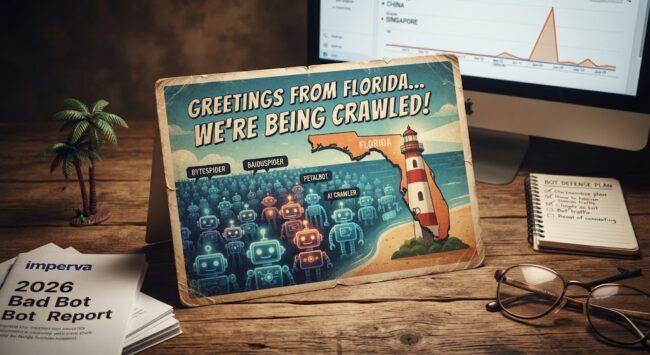
Since October 2025, website owners around the world have reported sudden jumps in direct traffic from Chinese IP addresses, with some sites seeing session counts rise 10 to 400 times overnight. A Google Analytics Community thread about bot traffic from China and Singapore hitting WordPress sites became a central gathering place for the complaints.
The scale of the shift is striking. AI bot tracker TollBit found bots visited websites once for every 31 human visits in late 2025, up from one bot visit per 200 human visits at the start of that year.
For a Florida dental practice, law firm, or roofing company, those visitors aren’t customers. They’re machines.
The Bigger Picture: Bots Now Outnumber People
Chinese bots are one slice of a much larger trend. Automated bot traffic made up more than 53% of all web traffic in 2025, up from 51% the year before, according to the 2026 Imperva Bad Bot Report. Of that, bad bots accounted for 40% of all traffic, while benign automation made up another 13%.
Cloudflare’s own data points the same way. CEO Matthew Prince shared figures in June 2026 showing bots now account for 57.5% of HTML requests across Cloudflare’s network.
| Measure | Figure |
|---|---|
| Bot share of web traffic (2025) | 53% |
| Bad bot share (2025) | 40% |
| Good bot share (2025) | 13% |
| Bot share of HTML requests (June 2026) | 57.5% |
Who Are the Chinese Bots?
Not all Chinese crawlers are the same. They fall into a few distinct groups.
AI training crawlers
Bytespider is the most talked-about. It’s operated by ByteDance, the Chinese company behind TikTok, Douyin, and the Doubao AI assistant, and it collects website content to train ByteDance’s AI models.
Bytespider has a reputation problem. ByteDance says the crawler follows robots.txt, the file websites use to tell bots what they can and can’t visit, but real-world evidence is mixed. Site operators, hosting providers, and Cloudflare have all reported it crawling pages that robots.txt explicitly disallowed.
Search engine crawlers
Baiduspider is the crawler for Baidu, China’s dominant search engine. Sogou Spider serves Sogou, another major Chinese search engine launched in 2004. YisouSpider builds the search index for Chinese search services in the Sogou and Shenma ecosystem.
These bots exist mainly to put web pages into Chinese search results.
Huawei’s PetalBot
PetalBot is the crawler for Huawei’s Petal Search, the default search engine on Huawei devices. It’s become a major source of AI traffic: DataDome ranked Huawei’s PetalBot the third-largest AI traffic source by company, generating 1.59 billion requests in the first half of 2026. Unlike Bytespider, PetalBot is generally seen as well-behaved and stops when blocked in robots.txt.
Unidentified traffic through Chinese cloud servers
Then there’s traffic that doesn’t announce itself at all. In one widely reported case, a weather site manager found bots routed through servers of major Chinese cloud companies including Tencent, Alibaba, and Huawei. After he blocked those servers, his daily bot visits fell from 127,000 to roughly 2,000.
Why Do They Want Your Website?
To train AI models
The main reason is data. AI models need enormous amounts of text to learn from, and English-language websites are especially valuable to Chinese AI companies. Some analysts link the surge that began in October 2025 to the training phase of many new AI models.
This isn’t only a Chinese phenomenon. Meta, OpenAI, Amazon, Anthropic, and Apple all run training crawlers too. According to DataDome, Meta alone generated 46.3% of tracked AI traffic in the first half of 2026, with OpenAI second at 34.6%.
To build search indexes
Baidu, Sogou, and Petal Search crawl the web the same way Google does: to decide which pages to show in their search results.
To probe for weaknesses
A smaller share of bot traffic is genuinely malicious, scanning for outdated software, testing stolen passwords, or hunting for vulnerabilities. Imperva found 27% of bot attacks targeted APIs directly in 2025.
One important caution: a Chinese IP address doesn’t prove a Chinese operator. Bad actors anywhere can rent servers in China or Singapore, and the origin of some of the 2025 surge remains uncertain even though it appears tied to Chinese infrastructure.
How Bot Traffic Hurts Florida Businesses
Distorted analytics. When bots inflate visitor counts, your conversion rates, bounce rates, and campaign results stop meaning anything. You can’t make good marketing decisions on bad data.
Advertising problems. Website owners have reported that bot-heavy traffic can damage ad revenue strategies, because platforms may conclude a site’s audience isn’t real. Colombian site owner Alejandro Quintero told Wired the bots were hurting his AdSense earnings.
Higher costs and slower sites. Aggressive crawlers can eat bandwidth and server capacity, which can slow your site for real customers and raise hosting bills.
Security risk. Malicious bots scanning for weaknesses are the real danger, especially for sites running outdated plugins or exposed login pages.
Content taken without credit. Training crawlers copy your content and send almost nothing back. One analysis found Anthropic’s ClaudeBot crawls roughly 23,951 pages for every one referral it sends, and Chinese training crawlers generally send none to U.S. businesses.
Should You Block Chinese Bots?
For most Florida businesses that don’t sell into China, the practical answer is: block the aggressive and unhelpful ones, and think carefully about the rest.
| Bot | Operator | Typical Recommendation |
|---|---|---|
| Bytespider | ByteDance | Block at server or firewall |
| Baiduspider | Baidu | Block unless you serve China |
| Sogou / YisouSpider | Sogou | Block unless you serve China |
| PetalBot | Huawei | Optional; obeys robots.txt |
| Unidentified cloud traffic | Unknown | Rate-limit or filter |
Be careful with blanket bans, though. Some experts advise against blocking all Chinese IP ranges and recommend per-bot and per-network rate limits, robots.txt rules for AI bots, and Cloudflare’s bot management tools instead.
What to Do: A Practical Checklist
- Check your analytics. In Google Analytics 4, review traffic by country and city. Sudden spikes from Lanzhou, Beijing, or Singapore with near-zero engagement time are a common bot signature.
- Update robots.txt. Add disallow rules for the bots you don’t want. It’s the polite first step, and well-behaved crawlers like PetalBot will comply.
- Block at the server or CDN level. Because robots.txt is only a request, use firewall or CDN rules (Cloudflare, Sucuri, or your host’s tools) to stop crawlers that ignore it, especially Bytespider.
- Turn on bot management. Many CDNs offer one-click AI crawler blocking and bot scoring.
- Filter your reporting. Create analytics filters or segments that exclude known bot traffic so your marketing data stays clean.
- Patch everything. Keep WordPress, plugins, and themes current, and protect login pages with strong passwords and two-factor authentication.
- Ask your web provider. If you don’t manage your own site, ask your developer or host what bot protections are in place.
Don’t Block the Bots That Help You
Here’s the AEO catch. Some AI crawlers are now how customers find you.
When a Tampa homeowner asks ChatGPT, Google, Perplexity, or Claude to recommend a contractor, those tools rely on content their crawlers have read. Blocking every AI bot can make your business invisible in AI answers.
The smarter approach is selective. Consider allowing the AI search crawlers tied to platforms your U.S. customers actually use, such as OpenAI’s OAI-SearchBot, Claude-SearchBot, PerplexityBot, and Google’s crawlers, while blocking aggressive training-only bots that offer your business nothing in return. ByteDance’s products, for example, don’t surface Florida service businesses to American buyers.
Frequently Asked Questions
Why is my website getting traffic from China?
Most of it is automated bots, primarily AI companies collecting training data and Chinese search engines indexing pages. Very little is likely to be real customers unless you do business in China.
Is Chinese bot traffic dangerous?
Most of it isn’t directly harmful, but it distorts analytics and uses server resources. A smaller share is malicious and scans for security weaknesses.
What is Bytespider?
Bytespider is ByteDance’s web crawler. It collects website content to train ByteDance AI models, and it’s widely reported to crawl aggressively and inconsistently follow robots.txt.
Will robots.txt stop Chinese bots?
It stops well-behaved crawlers like PetalBot. For bots that ignore it, you need server, firewall, or CDN-level blocking.
Should I block all traffic from China?
Usually not. Blanket country blocks can catch legitimate traffic and are easy for bad actors to route around. Targeted bot blocking and rate-limiting work better.
Will blocking bots hurt my Google rankings?
Blocking Chinese crawlers won’t affect Google. Blocking Googlebot or major U.S. AI search crawlers could hurt your visibility in search and AI answers.
Brian’s Take
The Chinese bot surge is a symptom of a bigger shift: your website is now being read by machines more than by people. That cuts both ways. The bots worth blocking take your content and give nothing back. The bots worth welcoming are the AI search crawlers that decide whether your business gets recommended. Florida business owners who learn to tell them apart will protect their data and keep their place in AI answers.
Sources and Further Reading
- Bad Bot Report 2026: Bots in the Agentic Age (Imperva)
- What Percent of Internet Traffic Is Bots? (2026) (TheBestVPN)
- AI Crawler & Bot Traffic Statistics 2026 (Digital Applied)
- Sudden Spike i Website Traffic from China (RW Digital)
- AI Bot & Agent Traffic Trends 2026 (DataDome)
- AI Scrapers from China: How to Defend Your Website in 2026 (AITraining2U)
- AI Agents Now Generate More Web Traffic Than Humans (The AI Career Lab)
About Brian French
This article combines human insight with tech-intelligent curation under our published Curation Protocols.Led by a commitment to tech-intelligent curation, Brian French tracks and analyzes Business News in Florida that defines Florida's economy. Brian brings an extensive financial background to his analysis, having graduated from the University of South Florida in Finance and serving as a Vice President and Portfolio Manager for Merrill Lynch Private Investors (a division of MLIM) and the Trust Department in St. Petersburg, FL, as well as a Vice President and Trust Investment Officer for SunTrust Bank in Sarasota, FL. His writing blends macroeconomic trends, capital markets analysis, corporate strategy, and modern digital insights for a sophisticated look at Florida's business news and economy.