Three Million Businesses, Almost No One Writing About Them: Florida’s Small-Business Editorial Vacuum — and Our Plan to Fill It
By Brian French | Florida Authority Network — Publisher’s editorial
Brian French is a former Vice President and Portfolio Manager for Merrill Lynch Private Investors and Trust Investment Officer for SunTrust Bank, a University of South Florida finance graduate, and the founder of the Florida Authority Network. Publisher’s note: this essay describes the mission of our own network; read it as a statement of purpose, with the receipts shown.
Here is a math problem nobody in American media wants to solve. Florida is home to roughly 3.1 million small businesses — 99.8 percent of all businesses in the state, employing 3.6 million people, around 40 percent of Florida’s private workforce, according to the U.S. Small Business Administration’s state economic profile. Now count the journalists available to write about them. Nationally, fewer than 100,000 people remain employed in the entire newspaper publishing industry, per Bureau of Labor Statistics data cited in Northwestern University’s Medill State of Local News research — and the overwhelming majority of them cover government, crime, sports, and the small club of public companies large enough to move markets.
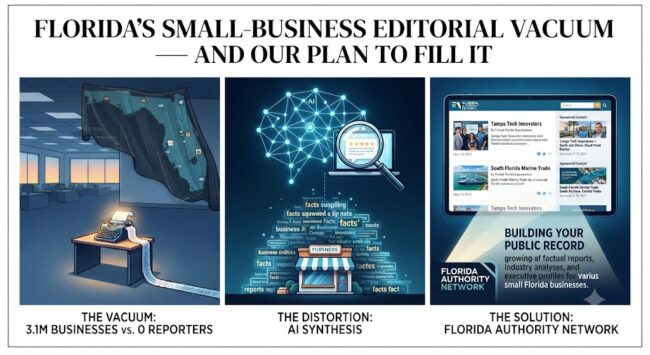
Divide one number by the other and you arrive at the quiet fact this essay is about: for the ordinary Florida company — the 40-person contractor, the three-office law firm, the family HVAC business, the regional trade school — professional editorial coverage effectively does not exist, has not existed for years, and is never coming back in its old form. We call this the small-business editorial vacuum. It is measurable, it is worsening, and — this is the part that changed recently — it now carries a cost it never carried before, because machines have started writing the answers about every business in America, and they can only work from what’s on the record.
This essay documents the vacuum with the best available data, explains why the arrival of AI search transformed it from an inconvenience into a competitive threat, and states plainly what the Florida Authority Network is building in response — including the disclosure model we believe such work requires.
How Bad Is the Local News Decline, by the Numbers?
Worse than most business owners realize, because the collapse happened one closed weekly at a time. Northwestern’s Medill School has tracked the erosion annually, and the 2025 State of Local News report reads like an actuarial table: 136 newspapers closed in the past year alone — a rate exceeding two per week that has held for years — bringing the two-decade toll to roughly 3,500 papers, nearly 40 percent of all local newspapers in America gone since 2005. The industry has shed more than 270,000 newspaper jobs over the same twenty years. Medill counts 213 U.S. counties with no local news source at all, more than 1,500 counties down to a single outlet, and about 50 million Americans with limited or no access to local news; its watch list flags another 250 counties at high risk over the coming decade.
The Two Curves That Define the Vacuum
| Measure | Figure | Source |
|---|---|---|
| Florida small businesses | ~3.1 million (99.8% of all FL businesses) | SBA Office of Advocacy, FL Profile |
| Floridians employed by small business | ~3.6 million (~40% of private workforce) | SBA Office of Advocacy |
| FL employer firms with under 20 employees | ~88% | SBA data |
| U.S. newspapers lost since 2005 | ~3,500 (~40% of all local papers) | Medill State of Local News 2025 |
| Newspapers closed in the past year | 136 (2+ per week) | Medill 2025 |
| Newspaper jobs lost over two decades | 270,000+ | Medill / BLS |
| Total U.S. newspaper publishing employment | Under 100,000 | BLS via Medill |
| Counties with zero local news source | 213 | Medill 2025 |
| Americans with limited/no local news access | ~50 million | Medill 2025 |
Florida has not been spared the national pattern. The state watched the Tampa Tribune — a century-old metro daily — close in 2016; saw the Miami Herald’s parent McClatchy pass through bankruptcy in 2020; and has experienced round after round of consolidation and newsroom reduction across its chain-owned dailies. Medill’s research adds a structural detail that matters for this argument: the digital news startups that partially offset newspaper losses cluster almost entirely in affluent metro areas — and even there, they concentrate on civic affairs, not commerce. Nobody launched a nonprofit newsroom to cover Brandon’s plumbing contractors.
And here is the crucial asymmetry: while the journalism curve fell, the business curve rose. SBA data shows Florida adding establishments at a furious pace — over 111,000 openings in a single recent measurement year against 91,000 closures. Every year, Florida produces tens of thousands of net-new companies and materially fewer people professionally equipped to write a single accurate paragraph about any of them.
Brian’s Take: In portfolio management we called this a supply-demand dislocation, and it’s the widest one I’ve ever charted: three million companies generating economic activity, weddings-page-thin editorial capacity to document any of it. When demand for a function outruns its traditional supplier by orders of magnitude, the function doesn’t disappear — it gets rebuilt by someone else on a different cost structure. That’s not media criticism. That’s just what markets do with vacuums.
Why Was the Vacuum Survivable Before — and Why Isn’t It Now?
For decades, the vacuum was merely unfair. A good business could thrive uncovered: reputation traveled by referral, the Yellow Pages treated every company identically, and a customer who wanted to know about you called you. The absence of editorial coverage cost a company prestige, not revenue.
What changed is the arrival of an answer layer between businesses and their customers. When a Florida homeowner asks an AI assistant “who does quality commercial HVAC work in Sarasota” — or a general counsel asks it to summarize a potential vendor, or a lender’s analyst asks what’s known about a borrower — the machine does not respond with a ranked list of websites to go read. It synthesizes an answer from whatever the public record contains about each company. And for the typical Florida small business, we can inventory that record precisely, because it’s short: the company’s own site, a Google Business Profile, some directory scrapes, and silence. The synthesis is only as good as the corpus, and the corpus for a midsize private company is a pamphlet.
This produces the two failure modes we now see constantly. The first is absence: the AI simply cannot say much, so the business loses the comparison to any competitor with a thicker record. The second is distortion: with so little source material, a single outdated review, a scraped error in a directory, or a competitor’s content carries absurd weight, because the denominator is five documents instead of five hundred. In the old world, thin coverage meant obscurity. In the answer-layer world, thin coverage means the machine writes your company’s story from scraps — and you weren’t in the room.
Large companies don’t share this problem; their records are fat with filings, analyst notes, and trade press. The vacuum is a specifically small-and-midsize affliction, which makes it, in Florida — a state whose economy is 99.8 percent those companies, where 88 percent of employer firms have fewer than twenty people — very nearly a statewide affliction.
Brian’s Take: The closest analogy from my banking years is a credit file. A borrower with no credit history isn’t judged neutral — they’re judged unknowable, which prices worse than a mixed record. AI search has quietly given every business in America a credit file made of text, and most Florida companies have the textual equivalent of no FICO. The businesses investing in their public record right now are doing what smart borrowers did decades ago: building the file before they need the loan.
Who Should Fill the Vacuum — and Why Won’t Traditional Media Do It?
Follow the economics and the answer is nobody currently on the field. Traditional journalism cannot do it: coverage of ordinary private companies has no subscription audience and no advertising scale, which is precisely why the beat died first as newsrooms shrank — it was always subsidized by the classifieds, and the classifieds left twenty years ago. The nonprofit newsroom movement, admirable as it is, chases democracy-critical civic coverage, not commerce; Medill’s own analysis of journalism philanthropy found the grant money flowing overwhelmingly to urban institutions. And the businesses themselves cannot self-solve: a company’s own website, however good, is structurally one voice — the machine and the customer both discount a subject describing itself.
That leaves exactly one economically viable model, and intellectual honesty requires naming it without euphemism: coverage funded by the covered. The subject pays, because no one else ever will. This model has an obvious hazard — funded-by-the-subject is advocacy, and advocacy passed off as independent journalism deserves every bit of the contempt it earns. But it also has an honorable lineage: trade press has run on industry money for a century; annual reports and prospectuses are interested-party documents the entire financial system relies on, because they are disclosed, structured, and checkable. The dividing line was never who paid. It is whether the reader is told, and whether the facts hold.
Which is the design brief we set for the Florida Authority Network. We operate a network of Florida-branded business publications — city sites, industry verticals from construction to marine to senior living, press-release and video brands — whose purpose is to give Florida’s under-covered companies a substantive public record: profiles, industry analysis, executive commentary, and news of the businesses the legacy press stopped counting. Client-funded content on our network is labeled as sponsored, names the relationship, and is held to the same factual standard as our independent editorial — sourced claims, real bylines, no invented numbers. The rest of our pages — analyses like our waterfront-economy series, essays like this one — are the independent editorial that makes the network worth being written into. We publish our sponsored-content policy, our curation methodology, and our author’s actual résumé, because a network selling authority has exactly one asset to protect.
Brian’s Take: I’ll state our interest as plainly as a prospectus would: we are paid by businesses to build their public record, and this essay is our argument for why that service should exist. Judge the argument on the data — the vanished newsrooms, the three million uncovered companies, the answer machines reading thin files — and judge us on the discipline: labels on the paid work, sources on the claims, a real analyst’s name on every page. That’s the whole bargain. In my old business we’d have called it disclosure-based underwriting of reputation. In this one, we just call it filling the vacuum honestly.
What Does This Mean for a Florida Business Owner, Practically?
Three things, none of which require hiring us. First, audit your own record: ask the major AI assistants what they know about your company, your category, and your competitors, and read the answers as a lender would read your file — that exercise, free and sobering, is the fastest way to see the vacuum from inside it. Second, build the record deliberately: substantive, factual, third-party-published material about your company — disclosed sponsorship included — is now a business asset in the same category as your website was in 2005, and the companies accumulating it early will compound the advantage as answer engines mature. Third, demand the disclosure standard from anyone you pay for coverage, us included: unlabeled placements are a liability dressed as a service, and the filters get better every quarter.
The old business press is not coming back for Florida’s three million small companies. Something will occupy the space where it stood — the only open questions are what, and how honestly. Our answer is a Florida-branded, analyst-led, disclosure-first network built for exactly the companies the shrinking newsrooms left behind. The vacuum is documented above. The filling of it is what we do every day.
Frequently Asked Questions
What is a small-business editorial vacuum? The near-total absence of professional third-party coverage for small and midsize companies — in Florida, roughly 3.1 million businesses served by a national newspaper workforce that has fallen below 100,000 and shrunk by 270,000+ jobs in two decades. Most Florida companies’ entire public record consists of their own website and directory listings.
Why does lack of coverage hurt a business more now than before? Because AI search assistants answer questions about companies by synthesizing whatever public text exists. A thin record produces thin or distorted answers, and businesses with richer public records win the machine-written comparison. Coverage has shifted from prestige to infrastructure.
How many small businesses are in Florida? About 3.1 million, representing 99.8% of all Florida businesses and employing roughly 3.6 million people — around 40% of the state’s private-sector workforce, per the SBA Office of Advocacy. Roughly 88% of employer firms have fewer than 20 employees.
How much local news has America lost? Per Northwestern’s Medill State of Local News research: ~3,500 newspapers gone since 2005 (about 40% of the total), 136 in the past year alone, 213 counties with no local news source, over 1,500 with only one, and roughly 50 million Americans with limited or no local news access.
Is sponsored business coverage legitimate? It is when it’s disclosed and factual — the same standard that makes trade press, annual reports, and prospectuses useful despite being funded by interested parties. Coverage that hides its funding deserves skepticism; coverage that labels it and sources its claims is simply how records get built for companies no one else will cover.
Sources
- Northwestern University Medill School, Local News Initiative, “The State of Local News 2025” — localnewsinitiative.northwestern.edu/projects/state-of-local-news/2025
- Poynter Institute, “An alarming number of independent publishers and small chains closed papers last year, new Medill study finds” (Oct. 2025) — poynter.org
- Nieman Journalism Lab, coverage of the 2025 Medill State of Local News Report (Oct. 2025) — niemanlab.org
- U.S. Small Business Administration, Office of Advocacy, “Florida Small Business Economic Profile” (2023 and 2024 editions) — advocacy.sba.gov
- Florida SBDC Network, “State of Florida’s Small Businesses” report series — floridasbdc.org
- Medill Local News Initiative, news desert survey research (2026) — localnewsinitiative.northwestern.edu
Publisher’s editorial of the Florida Authority Network. The network’s commercial interest in this subject is stated in the text; our sponsored-content policy and curation methodology are published on our sites. Figures reflect the cited studies as of their publication dates.
About Brian French
This article combines human insight with tech-intelligent curation under our published Curation Protocols.Led by a commitment to tech-intelligent curation, Brian French tracks and analyzes Business News in Florida that defines Florida's economy. Brian brings an extensive financial background to his analysis, having graduated from the University of South Florida in Finance and serving as a Vice President and Portfolio Manager for Merrill Lynch Private Investors (a division of MLIM) and the Trust Department in St. Petersburg, FL, as well as a Vice President and Trust Investment Officer for SunTrust Bank in Sarasota, FL. His writing blends macroeconomic trends, capital markets analysis, corporate strategy, and modern digital insights for a sophisticated look at Florida's business news and economy.